
SLATE • CHAPTER 1
From Internal Tool to a SaaS Platform
How one screen restructure saved a client relationship and unlocked a product vision


⎯ CONTEXT
GreyB & Slate
GreyB Research is an IP services firm they run prior art searches, patent landscape analyses, and invalidity studies for companies protecting or challenging intellectual property.
To deliver this work, GreyB's research teams needed a way to manage large volumes of patents: importing them, reading them, annotating relevant claims, categorizing them by taxonomy, and surfacing insights.
The work is meticulous, domain-heavy, and delivered to clients who expect precision. GreyB built a tool internally to handle this workflow called "Slate."
WHAT SLATE DID
One patent, one review. Analysts imported a portfolio, categorized patents, read and annotated them, and built insights, all in one place.
WHO USES IT
Patent research analysts and domain experts doing dense, high-stakes work under time pressure. The tool was supposed to make their job easier.
WHO BUILT IT
Developers solving a delivery problem. No UX input. No user research. No design system. Built for function, not for the people using it.
THE REALITY
The interface was overwhelming. Features existed but weren't findable. The IA reflected the data structure, not the analyst's thinking.
⎯ BUSINESS PROBLEM
One of GreyB's client research projects was winding down. The client relationship was at risk of not continuing, and the sales team was looking for a way to extend it.
The team's instinct was to add more features. In a team of 10, I took a different approach — before adding anything new, I wanted to understand whether the existing interface was actually working for the people using it.
That question led to the redesign.
⎯ MY APPROACH
Secondary research, a conversation, and a sketch
The time window was tight. I worked with what was available.
Studied Google Patents
To understand how a novice makes sense of patent data
Talked to domain experts
Sales and the lead dev — to understand how analysts actually work
Sketched a proposal
Grouped by analyst workflow
Lessons from Google Patents
01
Document title
Google Patents leads with a large, readable title. Analysts reviewing hundreds of patents had no quick way to orient themselves in Slate.
02
Visible filters
Filters by country, classification, and tier are central to patent analysis. On Slate, they were hidden.
03
Information hierarchy
Everything competed for attention equally. The layout reflected how data was stored, not how analysts moved through their work.
I mapped every element on the work page and grouped them by how analysts actually progress through a review. A three-column layout, reading left to right, arranged around how an analyst actually progresses through their work.
30%
Portfolio Data
Project-level context — the overall set, stats, and filters
30%
Classification
Taxonomy operations — where analysts categorize and organize
40%
The Document
The patent itself — given the most space because it needs the most focus
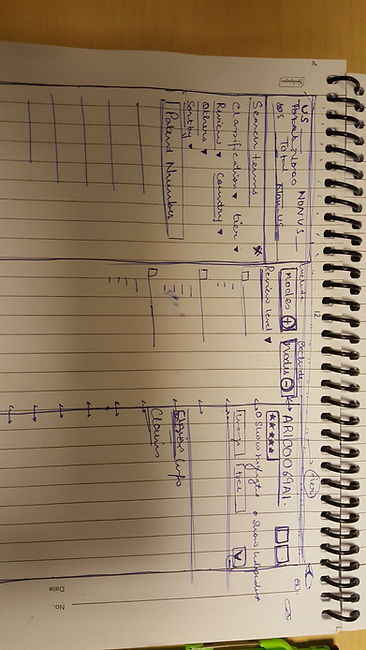
The sketch from the team exercise
⎯ OUTCOME
The redesign earned the renewal
The sales team used the redesign as part of a pitch to extend the client relationship. The client stayed.
It also changed how leadership saw the role of design at GreyB. I had come in as an experiment — the first UX hire, no formal experience, an unknown quantity. The redesign made the value of design visible in a way that was hard to argue with.

The mock-up the sales team took to the client
⎯ WHAT FOLLOWED
Slate as a product
Before the redesign, Slate existed to solve an internal delivery problem. There was no plan to sell it, scale it, or develop it as a standalone product.
When the solutions team saw what the tool could look like with intentional design, the conversation shifted. The question moved from how to deliver a specific project to whether Slate could be offered to clients directly.
In 2019, Slate launched as a SaaS platform. Every GreyB research project from that point was delivered through it.
